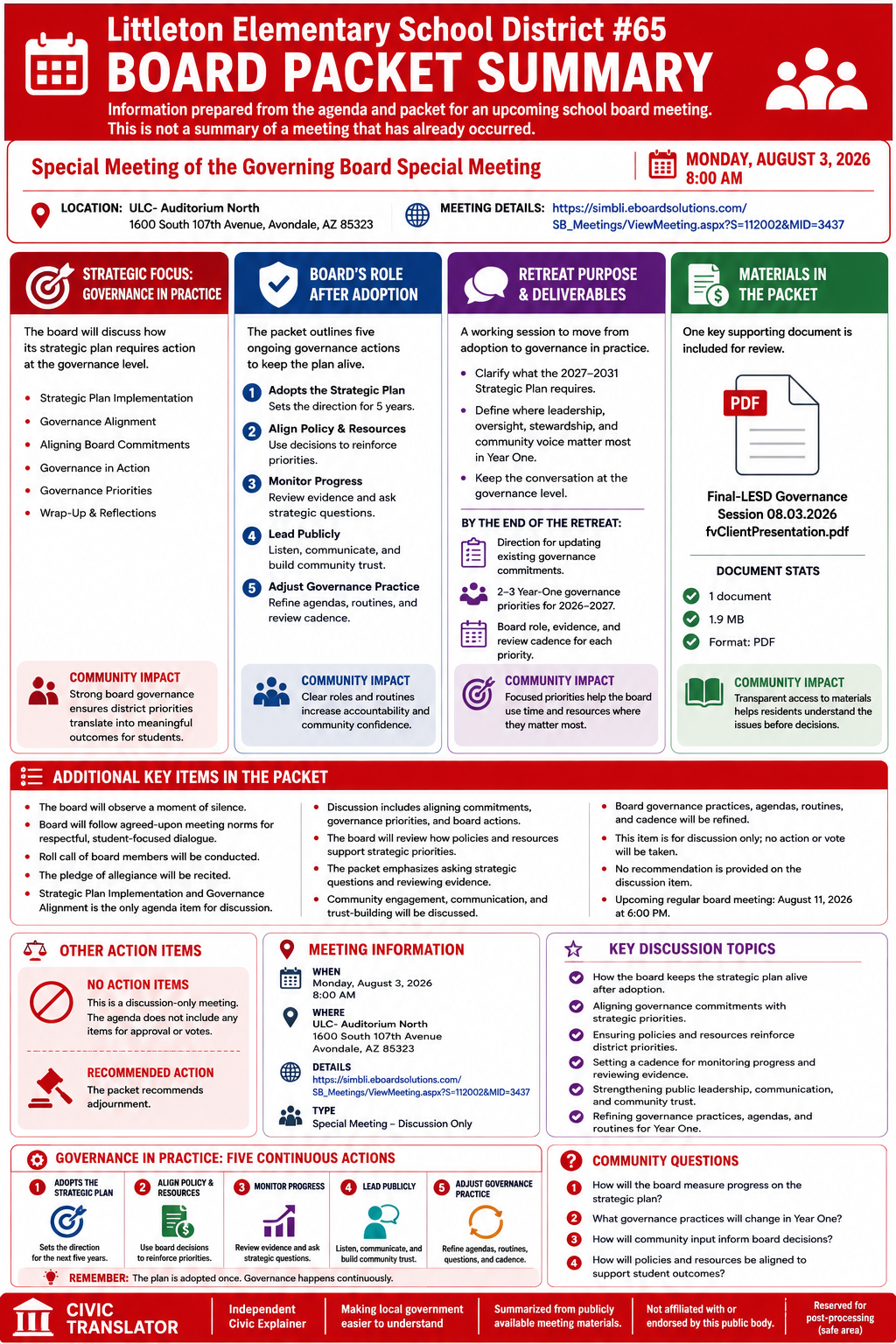
Littleton Elementary School District's August 3, 2026 special governing board meeting was structured as a strategic governance retreat rather than a regular business meeting. Instead of considering contracts, budgets, personnel actions, or policy adoptions, board members participated in a facilitated working session focused on how they should govern following adoption of the district's 2027–2031 Strategic Plan.
The central objective was to help the Governing Board distinguish its governance responsibilities from district administration. The retreat emphasized that the Board establishes vision, priorities, policy, oversight, and accountability, while the superintendent and administrative staff are responsible for implementation, staffing, operational management, and execution of district programs.
Participants were expected to identify two or three governance priorities for the 2026–2027 school year, determine what evidence should be reviewed to measure progress, and establish how frequently the Board should revisit those priorities. Rather than rewriting the strategic plan itself, the session focused on how Board meetings, questions, agenda structure, and oversight practices should evolve.
For community members, the meeting signals how the Board intends to oversee district performance over the coming years. While no immediate operational changes or major expenditures were proposed, the governance framework discussed during this retreat will influence future budgeting, strategic monitoring, policy decisions, superintendent oversight, and public accountability.
Major Discussion and Action Items
Strategic Plan Implementation and Governance Alignment
The principal discussion centered on translating the newly adopted 2027–2031 Strategic Plan into day-to-day governing practices. Board members explored what responsibilities become more important after adopting a long-range strategic plan and how governance should remain aligned with district priorities over the next five years.
Facilitators emphasized that adopting a strategic plan is a one-time action, while governance is an ongoing responsibility requiring continual monitoring, communication, and adjustment.
Discussion was scheduled only. No formal recommendation or vote accompanied this item.
Defining the Board's Proper Governance Role
A substantial portion of the retreat distinguished governance from administration.
According to the presentation:
- The Governing Board sets vision, goals, policy, priorities, and resource allocation.
- The Board monitors results through evidence and strategic questions.
- The Board represents the community and evaluates the superintendent.
- Administration develops implementation plans, manages staff, operates programs, prepares recommendations, and addresses operational issues.
Participants were encouraged to continually ask whether discussions remained focused on governance rather than directing day-to-day district operations.
Reviewing Existing Governing Board Commitments
Board members examined existing governance commitments, including:
- Student learning
- Safe and orderly schools
- Families as partners
- Competent and caring staff
- Community involvement
- Highly effective organizational leadership
Each commitment was evaluated to determine:
- Whether it should remain unchanged
- Whether it should be strengthened or clarified
- Whether it should receive special attention during the 2026–2027 school year
- What observable Board behaviors would demonstrate successful governance in that area
The exercise focused on Board responsibilities rather than administrative implementation.
Selecting Year-One Governance Priorities
After reviewing all governance commitments, Board members were expected to identify two or three priorities deserving concentrated attention during 2026–2027.
The workshop proposed using a structured process involving:
- Reviewing each commitment
- Identifying common themes
- Voting on priorities
- Reaching consensus
- Defining Board actions
- Identifying measurable evidence
- Establishing review schedules
An example priority included maintaining student achievement as a recurring Board oversight topic supported by scheduled performance reviews and strategic questioning.
Establishing Accountability Measures
Rather than creating operational performance plans, the retreat emphasized creating governance accountability.
For each selected priority, Board members were asked to define:
- The Board's specific role
- Evidence that would demonstrate progress
- How often progress should be reviewed
- How agendas and Board discussions should reflect those priorities
Example review timing included fall baseline reviews, winter progress reviews, spring progress reviews, and year-end reflection.
Reflection, Surveys, and Future Governance Improvement
The retreat included both beginning and ending surveys.
The opening survey asked members whether current governance practices adequately focus on strategic priorities, support productive relationships with administration, and position the Board to fulfill the Strategic Plan.
The concluding survey evaluated whether the retreat improved understanding of governance, identified priorities for improvement, and provided useful direction for future Board work. Open-ended responses were also collected regarding governance practices deserving additional attention.
Financial Matters
The packet does not include substantive financial actions requiring Board approval.
No contracts, bids, grants, purchases, budget amendments, bond matters, tax items, transfers, reimbursements, or funding requests with stated dollar amounts were presented for action.
The only discussion involving resources occurred conceptually, noting that future Board budget decisions should align district resources with strategic priorities established through the Strategic Plan. No financial appropriations were proposed during this meeting.
Policies, Ordinances, Resolutions, and Governance
The meeting focused on governance practices rather than formal policy adoption.
Key governance concepts included:
- Aligning Board decisions with the Strategic Plan.
- Updating existing governance commitments.
- Improving meeting agendas to emphasize strategic oversight.
- Strengthening Board accountability.
- Clarifying the distinction between governance and administration.
- Establishing recurring evidence-based review cycles.
The presentation repeatedly noted that the retreat was intended to establish governance direction rather than produce final policy language or administrative implementation plans.
The primary presentation, "Governance in Practice," served as the meeting's principal informational document.
Topics included:
- Governance after strategic plan adoption.
- Responsibilities of the Governing Board versus the superintendent.
- Board reflection on current governance practices.
- Governance commitments already guiding the district.
- Structured methods for selecting Year-One governance priorities.
- Accountability frameworks built around Board actions, evidence, and review cadence.
- End-of-retreat evaluation and future governance development.
Facilitators Dr. Andrea Thomas-Reynolds and Grant Guyer led the strategic governance workshop.
Personnel, Appointments, and Organizational Matters
The packet contains no proposed hiring, resignations, retirements, employment contracts, appointments, committee appointments, or personnel recommendations requiring Board action.
The superintendent's role was discussed from a governance perspective, emphasizing that the Board evaluates and supports the superintendent while administration remains responsible for implementation of district operations.
Projects, Facilities, Infrastructure, and Operations
No construction projects, maintenance initiatives, transportation changes, technology procurements, safety improvements, facility expansions, or capital projects were proposed.
Operational topics appeared only to reinforce that administration—not the Governing Board—manages implementation, staffing, programs, operational systems, and day-to-day district decisions.
The packet does not identify formal public hearings or public comment sessions tied to specific proposals.
The retreat nevertheless emphasized community engagement by identifying one of the Board's continuing responsibilities as listening to residents, communicating transparently, and building public trust.
The agenda identifies the next Regular Board Meeting:
For students and families, stronger governance oversight may result in greater attention to long-term student achievement, communication, and accountability rather than reactive operational discussions.
District employees may see clearer distinctions between Board oversight and administrative management, helping define decision-making responsibilities.
Taxpayers may benefit from governance practices that explicitly connect future budgeting and resource allocation to strategic priorities adopted by the Board.
Community organizations and residents may experience increased emphasis on public trust, communication, and transparent monitoring of district progress as Board governance becomes more structured.
Because this meeting was primarily a planning retreat, immediate operational impacts are limited, but the governance framework established here is intended to shape future Board decisions across multiple years.
- Which two or three governance priorities did the Board ultimately select for 2026–2027?
- How will residents be able to track progress on those priorities?
- What evidence will the Board regularly review to monitor student achievement?
- How frequently will strategic progress reports appear on Board agendas?
- How will governance commitments influence future budgeting decisions?
- What changes should the public expect in future Board meeting agendas?
- How will the Board measure whether it is remaining focused on governance instead of operations?
- How will community feedback inform governance priorities over the coming year?
- What indicators will demonstrate successful implementation of the Strategic Plan?
- Will governance priorities be formally incorporated into future Board policies or annual goals?
Important Dates, Deadlines, and Next Steps
- August 3, 2026: Special Governing Board retreat devoted to governance alignment and Strategic Plan implementation.
- 2026–2027 School Year: Board intends to implement selected Year-One governance priorities with defined evidence and review schedules.
- Fall 2026: Example governance framework recommends an initial baseline review of selected priorities.
- Winter 2026–2027: Example progress review.
- Spring 2027: Example additional progress review.
- Year-end 2027: Example reflection on governance performance.
- August 11, 2026, 6:00 PM: Next Regular Governing Board meeting.
Key Takeaways
- The meeting functioned as a strategic governance retreat rather than a traditional business meeting.
- No major financial approvals or contracts were presented.
- No personnel actions were scheduled.
- The Board focused on implementing oversight responsibilities tied to the 2027–2031 Strategic Plan.
- Governance and administration were deliberately distinguished throughout the workshop.
- Board members evaluated existing governance commitments.
- Participants worked toward selecting two or three governance priorities for 2026–2027.
- Future Board oversight is expected to rely on measurable evidence and scheduled progress reviews.
- Community trust and communication were identified as important governance responsibilities.
- The next regular Board meeting is scheduled for August 11, 2026.
Official Sources
About the Public Body
- Name: Littleton Elementary School District #65
- Organization type: school-district
- Government body: school-boards
- Location: Avondale, arizona
- County: Maricopa
- Provider: simbli
Keywords
Littleton Elementary School District #65, Governing Board, Special Meeting, board retreat, strategic plan, 2027–2031 Strategic Plan, governance, governance alignment, Board commitments, Board priorities, superintendent, student achievement, accountability, Board oversight, governance practices, Avondale, Maricopa County, Arizona, governance survey, community trust, Board agendas, strategic monitoring, Year-One priorities, governance reflection, Simbli, education governance, public schools, Board leadership, district strategy